
There were nine observed stake choices. The 0.1 setting showed 2× and RESPIN eligibility; 5× appeared at 1, Lucky Wheel at 5 and 10× at 10. A higher stake buys a different exposure and can unlock features. It does not establish a better expected return.
Nine selectable stakes, not one universal minimum
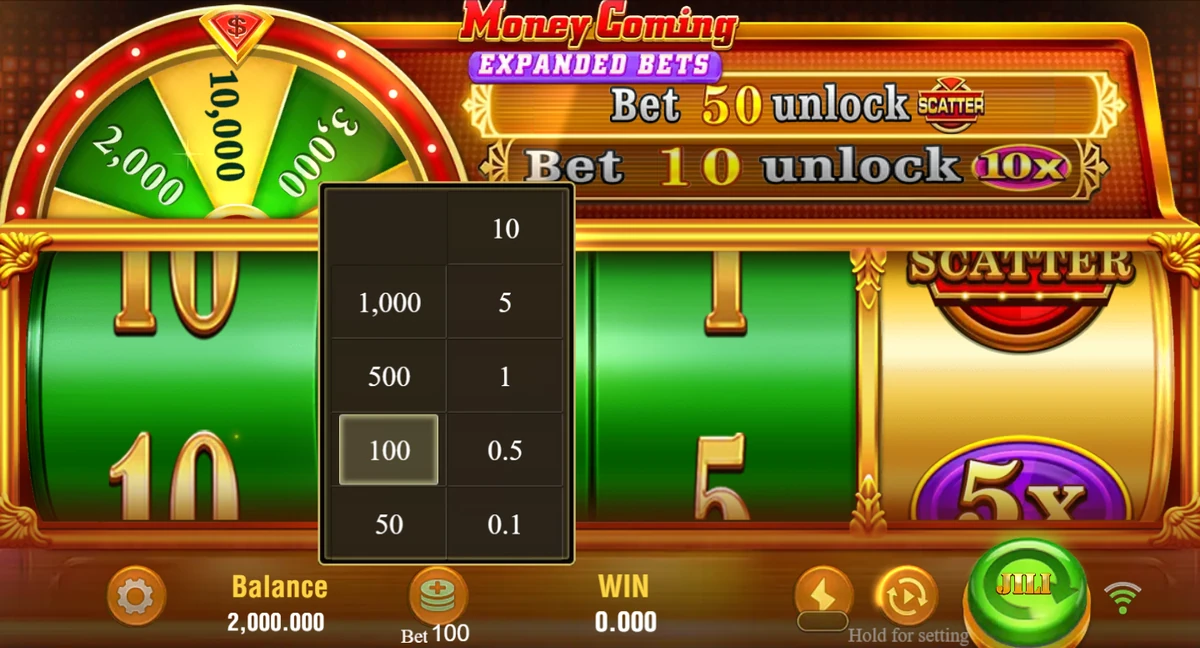
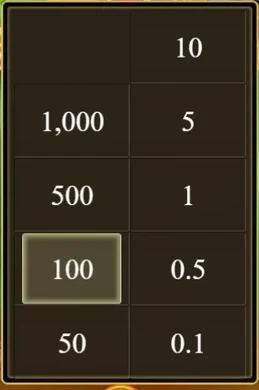
The inspected Expanded Bets menu lists 0.1, 0.5, 1, 5, 10, 50, 100, 500 and 1,000. Open the coin-stack control to see which values are actually available in the client you are using. A number in an explanation banner is not always a selectable bet. The menu is the direct check. The game’s help explicitly allows regional bet lists to differ, so an operator may not reproduce every value in this demonstration.
The original Money Coming menu we inspected started at 1 and ended at 100, with five choices. Expanded Bets adds smaller and larger options in its captured configuration. This is the practical meaning of the edition name. It does not mean every spin is automatically larger, that the game places several independent bets for you, or that a deposit buys a package of spins. You still need to choose a stake and accept each round or configured Auto Spin sequence.
Use the displayed units consistently. Our demo captures show virtual credits, not a confirmed peso balance. A minimum of 0.1 here therefore does not establish a ₱0.10 cash minimum at an operator. The same applies to the maximum of 1,000. Check the currency label in the account game before converting any example into a real-money budget. Multiplying by an assumed exchange rate would introduce a number that the demo never supplied.
Before your first trial round, check the selected value after closing the menu. Opening a list and looking at a row is different from applying a choice. Read the Bet field beside the controls, then decide whether the amount is appropriate for practice. A large default balance can make a selected stake look small; the cost per accepted round is still the number in Bet.
What becomes eligible at 0.1, 1, 5, 10 and 50?
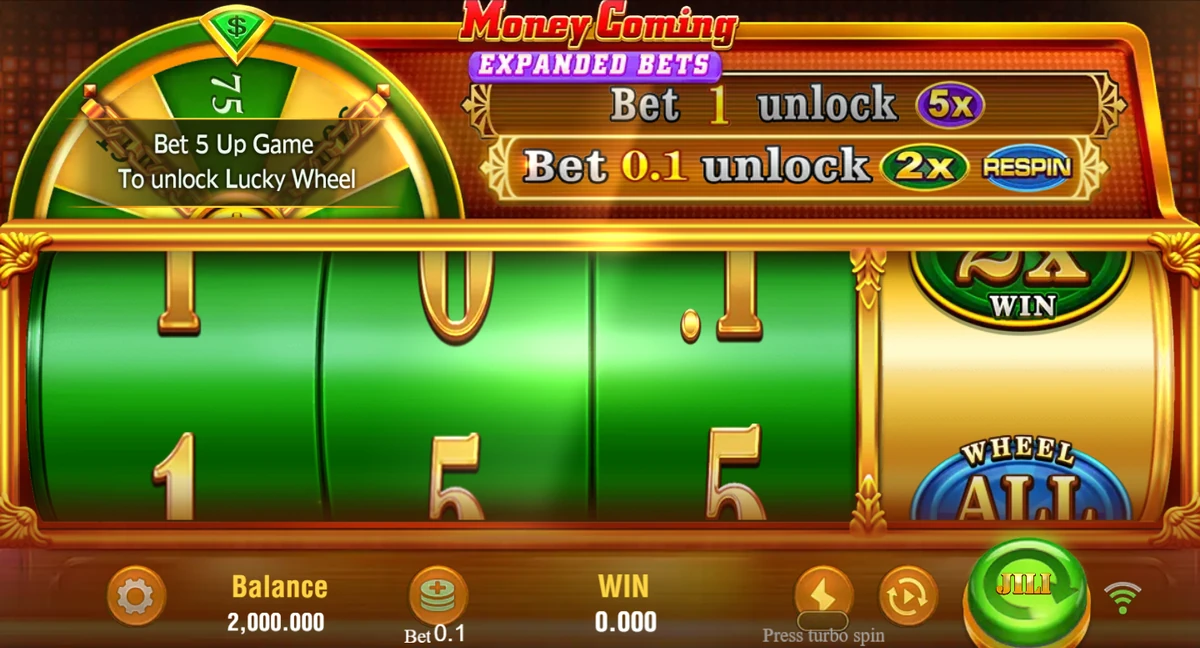
At 0.1, the captured banner showed 2× and RESPIN unlocked. At 1 it showed 5×, at 5 the Lucky Wheel, and at 10 the 10× feature. At 50 the green Scatter changes to the red Scatter in the displayed feature description. These values are thresholds in the inspected edition. They should not be transplanted into an original-game tutorial whose stake list and locks differ.
An unlock is permission for a feature to occur under the game’s rules. It does not mean the next spin must trigger it. For example, changing from 0.5 to 1 may make a 5× symbol eligible, but that alone gives neither its probability nor its average contribution to returns. Our control inspection did not measure the frequency of these symbols. We can describe the eligibility shown on screen without inventing a hit-rate table.
Compare the price change alongside the unlocked feature. Moving from 1 to 5 multiplies a round’s cost by five. Moving from 5 to 10 doubles it. Moving from 10 to 50 multiplies it by five again. If you plan twenty rounds, those stakes correspond to total amounts wagered of 20, 100, 200 and 1,000 before returns. The progression is not a small fixed upgrade fee: the selected amount applies to every accepted paid round.
This also limits strategy comparisons. A record of outcomes at 10 does not automatically tell us what would have happened at 50. The client’s available features differ. Simply multiplying every old payout by five is a mathematical scenario, not a replay of the actual higher-stake game. The strategy study shows that distinction explicitly, including the paid cost of waiting through losing rounds before a proposed increase.
Read the number result before the multiplier
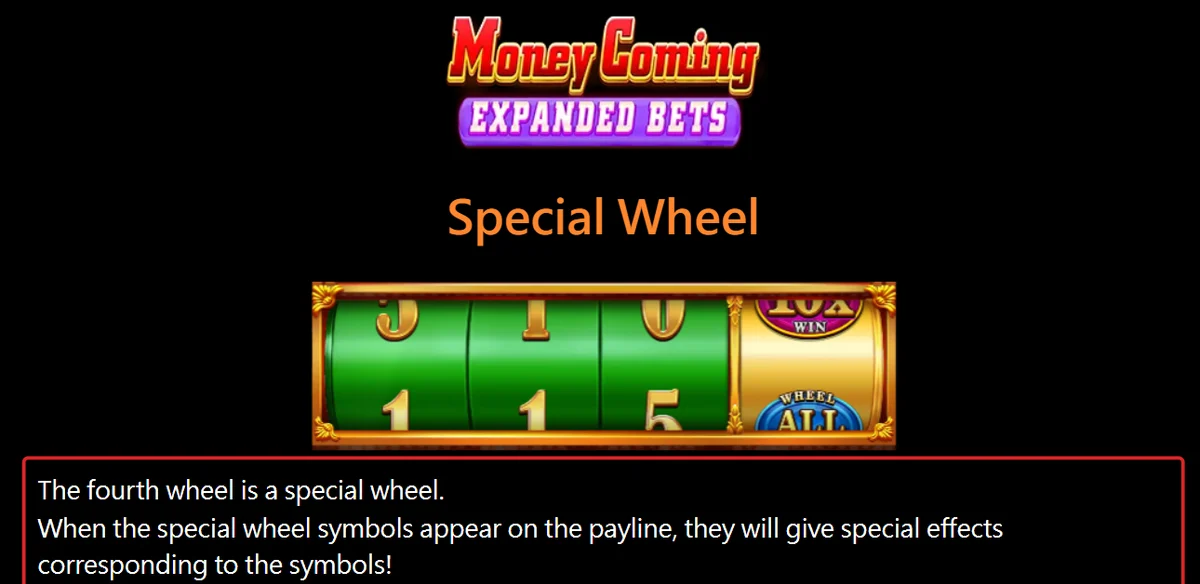
The basic reading order remains important: identify the settled number arrangement, then apply the active special result according to the help. Do not assume a large × label multiplies the stake directly. Our original-game example of number 5 and Special Wheel 10× returned 50 on a stake of 10. It illustrates the reading mistake, but it is not an observed Expanded Bets spin. The Expanded Bets images on this page document menus and explanations rather than a newly recorded payout sample.
Work through a hypothetical accounting example separately from the game’s payout rules. Suppose a paid round costs 5 and its final displayed return is 12. The net result is 7. If the next two rounds each return zero at the same stake, the three-round total is 15 staked and 12 returned, or −3. The visible winning animation in the first round does not make the complete sequence profitable. These selected numbers teach the calculation; they are not claimed captures from this edition.
The help describes a respin whose awards are added. Two feature amounts of 20 and 35 would total 55 before subtracting the paid stake; that is an arithmetic illustration. It would be wrong to double the first 20 and call the feature 40, or to count the final total again as an extra award. Use the final WIN and the balance change after the entire feature has finished. The original-game respins on video provide a real example of a feature settling over more than one animation.
The captured Expanded Bets help displayed a maximum label of 2,020× and maximum payout of 2,020,000 in its inspected context. A maximum is an upper-end rule label, not a typical outcome, a target expected within a session or a promised amount for every selectable bet. We have no measured frequency for it. Keep that label separate from the original game’s different help displays and from the sequel’s own rules.
Plan a practice session without confusing the editions
A useful first session has a learning task. Choose a small selectable stake, find the final WIN field and locate the rules without changing several settings at once. Record the chosen edition, stake and starting balance. After a round, write the return and ending balance. This is enough to detect whether you are reading gross returns as profits or including a feature animation twice. You do not need a complicated strategy to learn the accounting.
If your task is to compare controls, opening the menu is sufficient; a paid spin is not required for every inspection. Avoid starting autoplay just to see what its button does. In the original client a short tap immediately began a sequence, while holding opened settings. Check the instruction in the edition actually on your screen. A control that looks familiar is not a substitute for reading the current label and selected options.
A spending cap should include the waiting period of any proposed strategy. For example, four base rounds at 10 cost 40 before returns. A proposed fifth round at 50 adds another 50, making 90 of exposure for that five-round cycle. Calling the first four rounds “waiting” does not make them free. A personal slot does not provide your next four unplayed results for observation in the way a shared public-round game might.
If you stop, note why: planned count, chosen budget, provider message or another reason. Our original recording ended when the provider requested a break, not because a later result had been selected for the report. That boundary is part of the data. Reopening until a favourable short run appears would answer a different question from following one predefined session plan.
Compare the original rules and Money Coming 2 guide with this version, keeping notes labelled by edition. A minimum from Expanded Bets, a WIN UP description from the sequel and an original-game screenshot describe different products. Match all three to the edition you intend to open.
A five-round cycle: count the waiting cost
A wait-and-raise plan has two parts, and both have a price. Consider a hypothetical cycle with four rounds at 1 followed by one round at 5. If the first four return zero, they cost 4. The fifth adds 5, so the total stake is 9. A final return of 8 on the raised round would look like a winning spin relative to its own 5 stake, but the complete cycle would still be down 1. You need a total return above 9 to make that particular cycle profitable.
At a different pair of stakes, four rounds at 10 followed by one at 50 cost 90 before returns. A 50-credit return on the last round merely replaces that last stake and leaves the earlier 40 loss. This is why a strategy table needs both the selected-round net and the waiting-round net. Showing only the bet that was increased can make an expensive sequence look successful. These are illustrative calculations, not observed Expanded Bets outcomes or a recommendation to use those stakes.
Define the trigger precisely. “Four bad rounds” might mean four zero returns, four net losses, or four outcomes below a chosen multiplier. Those definitions can mark different rounds. A return equal to the stake is break-even, not a loss; a small positive return below the stake is still a net loss. Before comparing any backtest, ask which definition it used and when its counter resets.
Next define the duration of the increase. One raised round followed by a reset is different from continuing until a win, or doubling after each loss. The latter rules can produce a much larger next stake. A wider menu does not ensure that every desired amount is selectable: in the captured Expanded Bets menu, there is no separate 20 option between 10 and 50. A spreadsheet that doubles 10 to 20 has already left the observed menu unless it explains a different verified configuration.
Finally, distinguish a feature threshold from a strategy signal. Reaching a streak of losses is a property of the recorded past. Selecting a stake of 5 is an action that makes certain features eligible in this client. Neither establishes the next result. A genuine prospective comparison would keep the edition fixed, declare the exact selectable stakes beforehand and record every waiting and raised round. The original-game study illustrates the accounting problem while keeping its unverified higher-stake scenarios separate.
Open the Expanded Bets demo or compare account play
The Expanded Bets demo uses this edition’s official public JILI trial. It loads only after you press the launch button, so the article does not start a game or consume game traffic simply because you opened it. The provider controls loading and trial availability. If the embedded frame cannot start, the official new-tab link lets you try the same edition directly without installing an APK.
For account play, open the partner catalogue and search for Money Coming Expanded Bets by JILI. Match the full title and stake menu. Check the operator’s account eligibility, currency, payment and withdrawal terms before depositing.
An error during loading is not a completed round. If the game has already accepted a stake, wait for its result and consult the in-game balance or history where available. Do not classify a missing animation as a zero return simply to complete a spreadsheet. Likewise, a provider break prompt should be treated as a stop, not something to bypass with repeated new sessions. Controls, accounting and a sensible stopping point matter more than reproducing a highlighted win.
The comparisons here describe what the menus and help actually showed. We did not record a full Expanded Bets outcome sample or establish its official RTP. For a numerical experiment, use the 95-round original study with its stated edition and limitations. For this edition, the immediate benefit is knowing which bet you selected, which features are eligible and how much the next accepted round can cost.