
WIN UP can replace a blank between number arrangements on the first three reels. The inspected help lists a 1–1,000 stake range and a 2,020× maximum label. We inspected controls and rules, not a completed WIN UP payout; the live 95-round study belongs to the original game.
What WIN UP changes before a payout
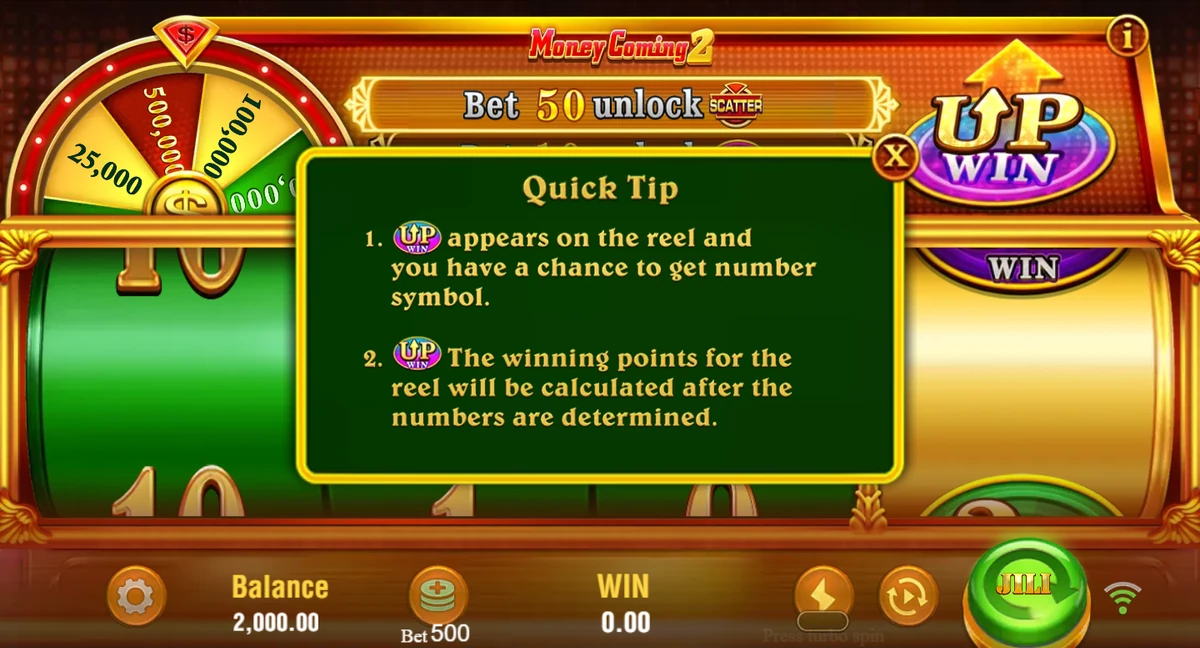
WIN UP concerns the number arrangement before the award is settled. The sequel’s full help describes replacing a blank between number arrangements on the first three reels, then resolving the numbers before calculating the payout. This is a different idea from simply multiplying the previous WIN by a fixed number. The shorter Quick Tip shown in our screenshot says that the numbers are determined before winnings; the detailed blank-replacement description comes from the full help.
Follow the order on screen. First a round is accepted at the selected stake. The reels and any relevant feature then resolve. Only after that sequence should you read the final amount and compare it with the cost of the round. A frame taken while symbols are moving can show a temporary arrangement. Do not treat that intermediate image as the completed result or count each movement as a separate paid spin.
The screenshot shows an explanation panel. We inspected the sequel’s rules and controls, but did not record a triggered WIN UP award or a separate outcome sample. The caption identifies the panel; the recorded live wins and respin video shown elsewhere come from original Money Coming, a separate edition.
If you want to learn the mechanism yourself, use the Money Coming 2 demo, open its information panel and compare the labels with this guide. You can inspect the rules without trying to force a particular symbol. There is no demonstrated timing action that makes WIN UP happen on the next spin. Reading the help explains how a feature is accounted for, not how to choose its random outcome.
Check the actual selectable stake
The inspected sequel help lists a minimum stake of 1 and a maximum of 1,000. Some generic feature text also mentions 0.1. Those two statements are not interchangeable. A feature threshold in explanatory text does not prove that 0.1 appears in the current selectable menu. Until the exact menu is checked in the client you open, use the stated 1–1,000 help range as a description of that inspection rather than a promise about every operator configuration.
This is one reason to keep separate pages for the three editions. Expanded Bets demonstrably offered 0.1 in its captured menu. Original Money Coming offered 1, 5, 10, 50 and 100. The sequel has its own help and WIN UP mechanic. Borrowing the lowest number from one edition would create an attractive-looking comparison that does not describe the actual product. A lower advertised minimum is only useful if you can select it in the game you intend to play.
Calculate exposure from the selected stake, not the largest displayed win. Twenty rounds at 1 cost 20 before returns; twenty at 10 cost 200; twenty at 100 cost 2,000. These examples use the same number of accepted base rounds. A free continuation within a feature should not be counted as another paid base round unless the actual client records another accepted stake. The balance is the practical check when an animation has several stages.
All such amounts on this page are credits unless a verified currency is explicitly shown. We did not establish Philippine-peso stakes in the public trial. A reader using an operator account should check the currency and the actual selected bet before copying a numerical example. The local language of a tutorial cannot make a virtual-credit screenshot a cash transaction.

A maximum label is not the ordinary result
The captured sequel help shows a 2,020× maximum label and a maximum payout of 2,020,000 in its inspected context. These values describe an upper-end rule display. They do not tell us the probability of that outcome, the typical return of a round or how long a player would have to play to see it. We have no measured maximum-win frequency for Money Coming 2 and no verified official RTP figure from this inspection.
Separate three questions when reading a large number. What does the help say is possible? What did a recorded round actually pay? What did the complete paid session gain or lose? A maximum label addresses the first. A settled screenshot can address the second. Only a complete ledger, with every accepted stake and return, can answer the third. None of these can safely replace the others just because a large win makes a better headline.
For a purely hypothetical example, a final WIN of 80 on a stake of 10 produces +70. If the next eight rounds at the same stake return zero, their combined net is −80 and the nine-round sequence finishes −10. A winning feature can be real while the surrounding session loses money. These figures explain session arithmetic; they are not presented as a played sequel sequence or an estimate of the feature’s likelihood.
The original-game 95-round research makes that distinction visible with a complete curve. It contains selected wins, a full-session loss and retrospective pattern tests. Its data are useful for learning how to read an experiment, but they cannot establish WIN UP frequency or a sequel strategy. The game identity belongs beside the sample size whenever you compare a result from another edition.
A careful first look on desktop or mobile
Load the sequel through its own free demo page. The page waits for your action before connecting to the provider. Read any provider introduction and consent choices rather than clicking through automatically. Once the controls appear, identify the stake field, balance, rules and Spin button. Checking those labels is a useful first task even if you do not place a round.
When switching between a wide browser and a phone-sized view, allow the client to lay out its controls again. A screenshot from the original does not prove that every sequel button occupies the same position. Use the label and current help to identify a control. If a small panel is hard to read, use the game’s available full-screen control or open the official trial in a separate tab rather than enlarging a blurred thumbnail.
Be especially cautious about controls that start repeated play. Inspect how the current client describes Auto Spin and its stop conditions before enabling it. A displayed limit can be inactive if its selector is not enabled. An upper or lower balance condition may refer to the account balance rather than the net result of the current session. These distinctions are visible in our original controls study, but the exact sequel controls should be checked on their own screen.
Speed controls affect how quickly an animation is presented. A faster animation is not evidence of a more favourable payout distribution. If you use a fixed number of practice rounds, count accepted paid rounds rather than seconds spent watching. If your purpose is learning WIN UP, an ordinary pace may make the sequence easier to follow. We have not measured a sequel-specific speed advantage, device benchmark or network-data saving.
If loading fails, the demo page retains an official new-tab link. Do not download an unrelated APK just because a search result has the same title. The app and browser guide explains the identity check. A public browser trial does not require entering an operator password into this guide. The guide does not host a login form or collect account credentials.
The first screen can already have a large bet selected
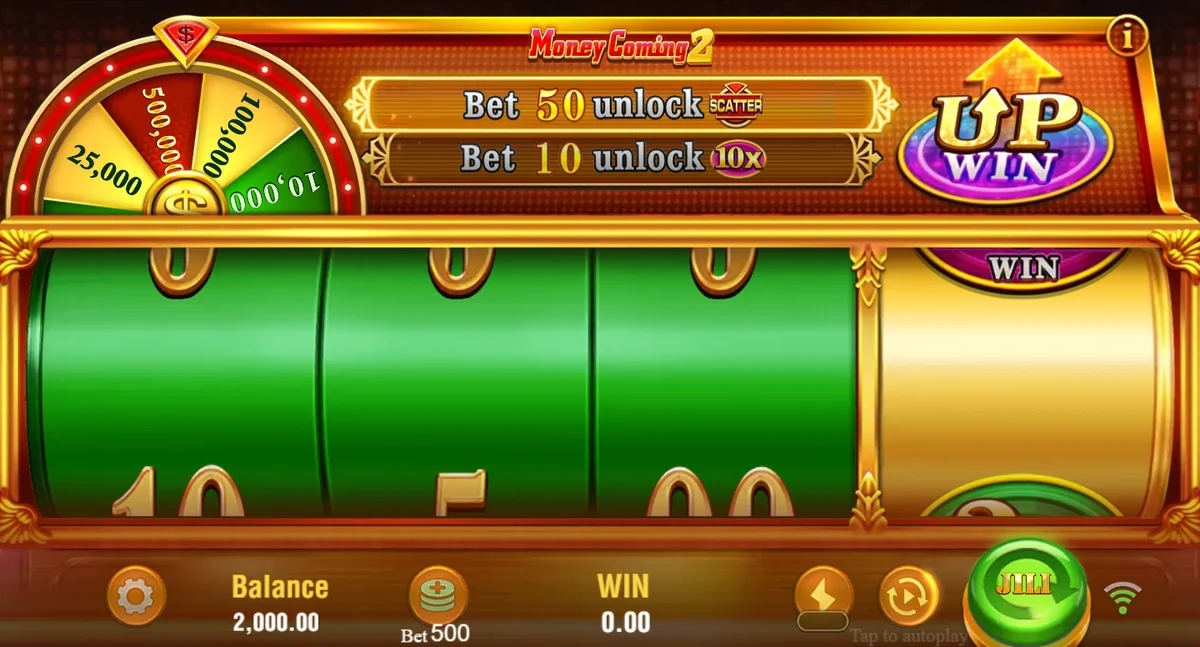
Our captured sequel screen showed a balance of 2,000, Bet 500 and WIN 0 before a recorded spin. This is a controls inspection, not a 500-credit loss or a completed round. The important practical detail is the selected bet: a first screen is not guaranteed to choose the minimum from the help. Always read Bet before touching the large green Spin control. Four zero-return rounds at 500 would consume 2,000; that arithmetic explains why the initial selection matters.
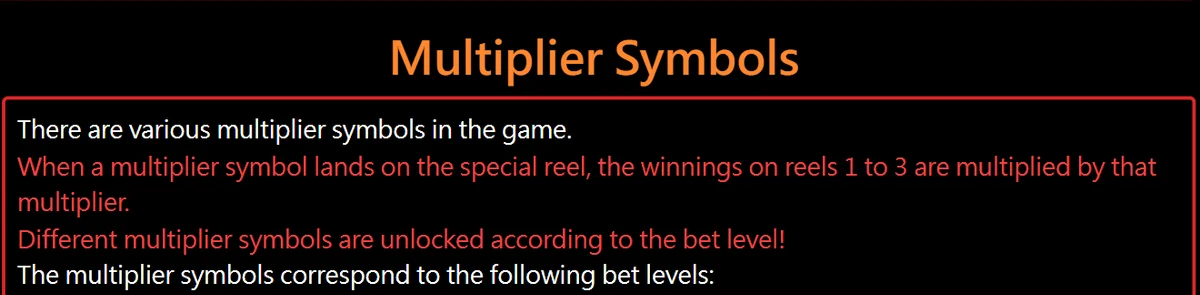
The top of the same screen showed Bet 50 unlocking the Scatter feature and Bet 10 unlocking 10×. A selected 500 is above those displayed thresholds, but that does not tell us a trigger frequency. The screenshot also has the WIN UP identity at the upper right. Together, these visible clues help distinguish the sequel from a cropped original-game reel picture. They are more useful for identifying the client than the size of a promotional maximum-win headline.
For a hypothetical budget of 100 credits, a single 500-credit stake would exceed the entire allocation. The right response is to check the available menu and select an amount within the planned budget, or stop if no appropriate choice is available. A large demo starting balance should not silently redefine the amount you intended to practise with. This is an interface-reading lesson, not a claim that a particular budget will last a certain number of real winning or losing rounds.
Keep a before-and-after note if you want to understand the first completed round. Before: edition, selected Bet and balance. After: final WIN and settled balance. Check starting balance minus stake plus return against the ending figure. If a feature is still running, the after entry is not ready. If the client rejects a stake, do not enter a completed loss merely because the button was pressed. The note should reflect what the game accepted and settled.
The image here is a genuine captured ready-screen state. It preserves the selected 500 and the zero WIN rather than replacing them with a more convenient example. The numeric tutorial elsewhere uses clearly hypothetical amounts when explaining arithmetic. Separating a real control capture from a worked example lets you understand both without believing that every displayed arrangement was a winning outcome we played.
Choose the sequel for its own feature, not borrowed results
Choose Money Coming 2 if the WIN UP mechanism is the feature you want to inspect. Choose Expanded Bets if your immediate question concerns its wider observed stake list. Start with the original illustrated guide if you want real settled examples of joining number marks and reading the special multiplier. These are different tasks, and keeping them separate makes the next click useful.
The original recording used a fixed stake of 10 for 95 completed rounds across two sessions. It cannot be relabelled as a sequel test. The numbers 613 returned and −337 net describe that original corpus only. Neither the shared family name nor a similar maximum label makes the same outcomes a forecast for Money Coming 2. A valid sequel outcome study would need its own accepted stakes, completed features and reconciled balances.
The same care applies to a strategy such as waiting through four losses and raising the next bet. In a personal slot, seeing those four results normally means paying for them. Their cost belongs in the strategy. In addition, a different stake can change eligible features. A proportional spreadsheet may produce an appealing number while describing a game configuration that was never actually observed. Our research keeps such arithmetic models visibly separate from recorded play.
For a useful personal note, record the exact edition, selected stake, starting balance, number of accepted rounds and ending balance. If a feature spans several animations, give it one completed-round entry unless a new paid stake is accepted. This simple record answers the immediate question of what was spent and returned. It does not predict the next random outcome, but it prevents a memorable highlight from replacing the complete session in your judgement.
Open the partner catalogue and search for Money Coming 2 by JILI. Match the full title, then check the game’s currency, your account eligibility and the operator’s terms before depositing. Use this sequel’s rules to compare the stake and features.